
What you’ll get from this article
- Define freight class in invoice language. Why Class 70 vs Class 125 changes the rate per hundredweight even when weight stays the same.
- Separate class from the NMFC item. The rate tier versus the commodity code that belongs on the bill of lading.
- Calculate density the way terminals measure it. Loaded-pallet L × W × H, cubic feet, and pounds per cubic foot—with a worked example.
- Use the post-2025 density-to-class chart. The 13-subprovision scale that followed NMFTA Docket 2025-1.
- Declare class so quotes survive inspection. A pre-booking checklist, plus what happens when the class is wrong.
- Connect to tools you already have. Density-class estimate and pallet layout before you book.
Two pallets leave the same dock on the same day. Same destination. Similar weight. One invoices at Class 70. The other comes back as Class 125 after a terminal inspection. The difference is not mysterious carrier magic—it is freight class: the LTL price tier that usually follows density, and sometimes follows a commodity rule that overrides density. If you only know the weight on the scale, you do not yet know what the shipment will cost.
Why freight class keeps showing up on the invoice
Less-than-truckload carriers sell shared trailer space. They price that space with a rate per hundredweight (CWT) that depends on lane, weight break, and freight class. Class is the standardized difficulty tier for moving the freight: denser, easier, lower-liability freight tends toward lower class numbers and lower rates; light, bulky, fragile, or awkward freight tends toward higher class numbers and higher rates.
The issue is not that class is complicated. The issue is that teams often treat it as a lookup they did once, or a number copied from last year’s BOL, while carriers measure the loaded cube at the terminal and re-rate when the declaration does not hold. That gap is how reweigh and reclass charges appear after the freight has already moved.
This article is the foundation piece: what class is, how the National Motor Freight Classification (NMFC) assigns it, how density is calculated, what changed in the July 2025 reform, and what to do before booking so the quote and the invoice use the same facts.
Freight class in one snapshot
Keep these five ideas together when someone asks “what class is this?”
- Class = price tier. Numbers from 50 (most favorable) to 500 (least favorable).
- NMFC item = commodity rule. The code that maps your product and packaging to a class or density scale.
- Density usually drives class. Weight ÷ cubic feet of the loaded handling unit.
- Four factors still matter. Density, stowability, handling, and liability—density first for most items after 2025.
- Wrong class becomes money. Terminal inspection → reclass → higher CWT rate on the invoice.
What LTL freight class actually is
Freight class is a standardized rating category used across much of North American LTL. There are 18 classes from 50 to 500. In plain terms:
- Lower class number → generally denser / easier freight → lower rate per hundredweight.
- Higher class number → generally lighter, bulkier, or harder freight → higher rate per hundredweight.
Class is not the same as billable weight. In parcel, cube often becomes a dimensional weight that replaces scale weight. In LTL, cube usually becomes density, density becomes class, and class multiplies the CWT rate applied to billed weight. Same physical idea—space costs money—different path to the invoice. See billable weight explained for the parcel side of that story.
NMFC item vs freight class
Shippers mix these two labels constantly. Keep them apart.
Two different numbers on the same shipment
NMFC item number
Commodity code
- Identifies the product / packaging provision in the NMFC
- May fix a class, or point to a density scale
- Belongs on the bill of lading when required
- Look up in ClassIT+ / current NMFC data—not memory
Freight class
Rate tier (50–500)
- What the rating engine multiplies against CWT
- Often the output of density + the NMFC item
- What changes when a carrier “reclasses” you
- What procurement compares when shopping rates
Two pallets at the same density can still land on different NMFC items if one is hazardous, fragile, high-value, or packaged under a special note. Density estimates class; the current NMFC item confirms it.
The four factors behind classification
The Freight Classification Development Council evaluates commodities on four transportation characteristics (sometimes summarized as density, handling, stowability, and liability). That framework has not disappeared. What changed is emphasis.
- Density — weight relative to space (pounds per cubic foot). Primary driver for most density-based items.
- Stowability — how well the freight fits with other freight (stackability, irregular shape, orientation).
- Handling — special care, equipment, or labor to load and unload.
- Liability — risk of theft, damage, spoilage, or harm to other freight.
If your commodity has no special handling, stowability, or liability issues, density usually decides the class under the reformed density items. If it does, the NMFC item may lock a higher class even when density looks “cheap.”
What changed in July 2025 (Docket 2025-1)
On July 19, 2025, NMFTA implemented Docket 2025-1—one of the largest NMFC updates in decades. In practical shipper language:
- Roughly 2,000 commodity listings moved toward density-based classification rather than long commodity-specific class lists.
- The standard density scale expanded from 11 to 13 subprovisions, adding clearer breaks for very dense freight at Class 55 and Class 50.
- NMFTA launched ClassIT+ as the digital home for classification data (replacing legacy ClassIT).
Follow-on dockets (including 2026 activity) continue cleaning legacy items. The operating implication for your warehouse is simple: dimensions and weight on the loaded unit matter more than a remembered class number. If your BOL process still skips cube, the reform made that habit more expensive—not less.
Classification standards evolve. Confirm the current NMFC item and density notes for your commodity before you treat any chart—including the one below—as final for a live tender.
How to calculate density (and estimate class)
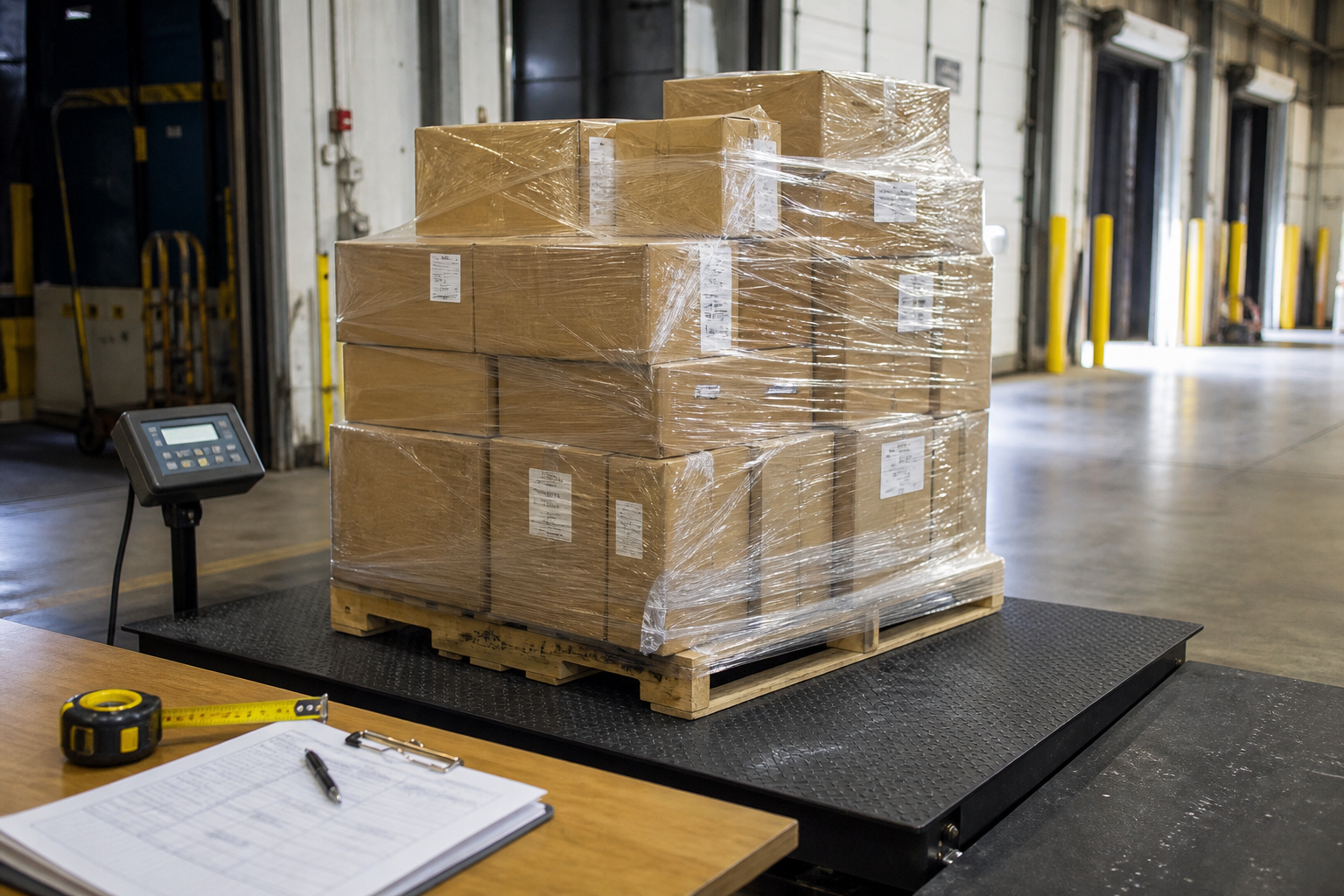
Terminals measure the handling unit as it sits ready to load—not the product box alone. Include pallet, overhang, wrap, and stacked height.
Density formula (imperial)
Cubic feet = (L × W × H in inches) ÷ 1,728
Density (lb/ft³) = Total weight (lb) ÷ Cubic feet
1,728 is 12 × 12 × 12—the cubic inches in one cubic foot. Use the full loaded footprint and height the carrier will see.
Worked example
Hypothetical scenario. One pallet: 48″ × 40″ × 54″ loaded height (including pallet), total weight 648 lb including pallet and packaging.
- Volume = 48 × 40 × 54 = 103,680 cubic inches
- Cubic feet = 103,680 ÷ 1,728 = 60.0 ft³
- Density = 648 ÷ 60.0 = 10.8 lb/ft³
- On the density scale below, 10.8 falls in 10 but less than 12 → provisional Class 92.5
If the warehouse had measured only product cartons and ignored pallet height and overhang, density would look higher and class would look cheaper—until the terminal measured the real cube. That is a classic path to reclass.
Free calculator
Estimate density-based freight class
Enter L × W × H and weight. See density and an estimated LTL class—then confirm against the current NMFC item for your commodity.
Density-to-class chart (post Docket 2025-1)
For commodities rated on the standardized density scale, match pounds per cubic foot to class using the 13-subprovision structure that took effect with Docket 2025-1. This is a density estimate, not a substitute for the NMFC item when handling, stowability, or liability notes apply.
| Density (lb per cubic foot) | Freight class | What it usually means |
|---|---|---|
| Less than 1 | 400 | Extremely light / bulky for its weight |
| 1 but less than 2 | 300 | Very low density |
| 2 but less than 4 | 250 | Low density |
| 4 but less than 6 | 175 | Light freight relative to cube |
| 6 but less than 8 | 125 | Below-average density |
| 8 but less than 10 | 100 | Moderate density |
| 10 but less than 12 | 92.5 | Moderate-high density |
| 12 but less than 15 | 85 | Good density for many pallet programs |
| 15 but less than 22.5 | 70 | Dense freight—often favorable rates |
| 22.5 but less than 30 | 65 | Very dense |
| 30 but less than 35 | 60 | High density |
| 35 but less than 50 | 55 | New dense tier on the expanded scale |
| 50 or greater | 50 | Highest density tier on the scale |
Other class numbers (for example 77.5, 110, 150, 200, 500) still appear in the broader 18-class system when specific NMFC provisions assign them. Do not force every product onto this density table if the item says otherwise.
How class shows up in dollars
LTL linehaul is typically:
Class enters the rate, not the weight
Freight charge ≈ (Billed weight ÷ 100) × Rate per CWT for that class
Fuel and accessorials stack on top. A reclass raises the CWT rate even when billed weight is unchanged.
Illustrative only. Same 500 lb billed weight on a given lane. If Class 70 rates at $32 / CWT, linehaul ≈ 5 × $32 = $160. If the shipment is reclassed to Class 125 at $48 / CWT, linehaul ≈ 5 × $48 = $240—a $80 difference before fuel. Your contract’s actual CWT table will differ; the mechanism does not.
That is why “we weighed it correctly” is not enough. Weight and class are separate levers on the same invoice.
Mixed commodities on one pallet
When a pallet mixes items of different classes and the bill of lading does not itemize them, carriers commonly rate the entire handling unit at the highest (least favorable) class present. The NMFC mixed-shipment logic exists so terminals are not forced to break down every skid. If you ship mixed SKUs on one pallet, itemize on the BOL—or expect the expensive class to win.
Pre-booking checklist: declare class so it survives inspection
Before you tender
- Weigh the full unit. Product + pallet + packaging on a calibrated scale.
- Measure the loaded cube. L × W × H including overhang and actual stacked height.
- Calculate density. Weight ÷ cubic feet → provisional class from the density chart.
- Confirm the NMFC item. Current provision for this commodity and packaging—not last year’s number.
- Put both on the BOL. Item (when required) and class consistent with that item.
- Keep evidence. Scale ticket, photos of the loaded unit, and the classification reference you used.
If you are still designing how cartons sit on the skid, model height and piece count with the Skid Builder before you lock dimensions on the tender. Cube decisions on the dock are class decisions on the invoice.
When the class is wrong
Wrong class usually shows up as a reclass line after terminal inspection: higher class, higher CWT, invoice above quote. Sometimes the carrier is correcting a genuine under-declaration. Sometimes dimensions were measured differently, the wrong NMFC item was applied, or packaging notes were missed.
For the dispute workflow, documents, and prevention steps after the invoice arrives, use the companion article: LTL Reweigh and Reclass Charges Explained. This page is how to get class right upstream; that page is how to audit it downstream.
What this guide does not replace
- The current NMFC / ClassIT+ item for your exact commodity and packaging
- Your carrier’s tariff, FAK program, or contract exceptions
- Legal or claims advice on liability limits
- A promise that denser packing always saves money—damage, stackability, and labor can offset rate gains
NMFC is a voluntary industry standard widely used in LTL rating. Carrier-specific density tariffs and FAK (Freight All Kinds) agreements can change how class appears commercially. Read your contract the same way you read the classification: against real shipments. See carrier contract rate analysis & optimization.
FAQ
What is LTL freight class?
A standardized LTL price tier from 50 to 500. Lower numbers generally mean denser, easier freight and lower rates per hundredweight; higher numbers mean lighter or harder freight and higher rates.
How do you calculate freight class from density?
Measure loaded L × W × H in inches, divide by 1,728 for cubic feet, divide weight by cubic feet, then match density to the current NMFC density-to-class scale. Confirm the NMFC item before you tender.
What is the difference between freight class and an NMFC item number?
Class is the rate tier. The NMFC item is the commodity provision that maps your product to that tier or to a density scale. Put the item on the BOL when required; the class is what the rating engine uses.
What changed in the July 2025 NMFC reform?
Docket 2025-1 (effective July 19, 2025) moved a large set of commodities toward density-based classification and expanded the density scale to 13 subprovisions, including Class 55 and Class 50 for denser freight. Always verify current items in ClassIT+.
Why does wrong freight class raise the invoice?
Carriers can reclassify after inspection. A higher class raises the rate per hundredweight even if weight is unchanged—one of the main reasons LTL invoices exceed quotes.
Conclusion
Freight class is how LTL turns cube and commodity risk into a rate tier. Density is the math most shippers can control on the dock: measure the loaded unit, weigh it, calculate pounds per cubic foot, then confirm the NMFC item—not a class remembered from last year. After the 2025 reform, that discipline matters more, not less.
The standard I use is simple: the class on the BOL should be the class a terminal would calculate from the same facts. When that is true, quotes survive inspection. When it is not, the invoice will teach the difference.
Class follows density and the NMFC item—not intuition. Measure the loaded cube before you book.