

What you’ll get from this article
- Define billable weight in one sentence. The weight the carrier uses to rate the shipment—usually the greater of actual and dimensional weight.
- Separate actual, dimensional, and billable weight. What each means and how they are determined.
- Calculate billable weight. Cubic inches, DIM divisor, and the greater-of rule—with plain numerical examples.
- Know when actual wins vs when DIM wins. Dense freight vs light, bulky freight.
- Account for exceptions. Rounding, minimums, and carrier-specific rules that change the invoice.
- Reduce billable weight where it matters. Cube, pieces, mode, and contract—plus a free calculator.
What is billable weight?
Billable weight is the weight a carrier uses to calculate the shipping charge. In most parcel shipments, it is the greater of the package’s actual scale weight and its dimensional weight.
Free billable weight calculator
Calculate actual vs dimensional weight
Enter dimensions, scale weight, and the carrier divisor to see which weight the rate uses—before you quote.
Billable weight vs actual weight
Actual weight is what a calibrated scale reads for the ready-to-ship package. Billable weight is what enters the rate table after dimensional rules (and any minimums) run. They match when the scale is heavier than the size-based calculation. They diverge when the package is light but bulky—then dimensional weight usually becomes billable weight.
Actual weight vs dimensional weight vs billable weight
| Weight type | Meaning | How it is determined |
|---|---|---|
| Actual weight | The package’s physical weight | Measured on a scale |
| Dimensional weight | A calculated weight based on package size | Length × width × height ÷ DIM divisor |
| Billable weight | The weight used to calculate the rate | Usually the greater of actual and dimensional weight |
Two plain examples
Example 1 — dimensional weight wins
Scale
Used for the rate
Greater of 10 and 18
Example 2 — actual weight wins
Used for the rate
Greater of 25 and 12
Size-based
A compact, heavy package bills on the scale. A light, bulky package bills on size.
Free calculator
Calculate your billable weight
Enter the package dimensions, actual weight, and carrier divisor to see whether actual or dimensional weight will be used.
How to calculate billable weight
- Weigh the ready-to-ship package → actual weight
- Measure outer L × W × H (longest points, including packaging)
- Compute volume → cubic inches (or convert to cubic feet)
- Divide by the carrier’s DIM divisor → dimensional weight
- Take the greater of actual and dimensional → billable weight (unless a minimum or other rule applies)
Working rule (most parcel tariffs)
dimensional weight = (L × W × H) ÷ divisor
billable weight = greater of (actual weight, dimensional weight)
Confirm the divisor and rounding sequence in your carrier’s tariff for your service.
What is dimensional weight?
Carriers move both weight and volume. A trailer or courier container fills when it hits a weight limit or runs out of space—whichever comes first. Dimensional weight (dim weight) turns outer size into a weight the tariff can use, so light-but-bulky freight pays closer to the opportunity cost of the space it uses.
It is not a physical weight you can lift. It is calculated from length, width, and height (usually the longest points of each side, including packaging), using rules the carrier publishes.
North American parcel math
In Canada and the United States, parcel tariffs are usually written in inches and pounds. Measure the carton, compute volume in cubic inches, then apply a published dimensional divisor.
From inches to cubic inches and cubic feet
Measure length, width, and height in inches—each at the longest point of the ready-to-ship package. Multiply to get cubic inches. There are 12 × 12 × 12 = 1,728 cubic inches in 1 cubic foot:
Why 1,728 cubic inches matters. A package totaling 1,728 cubic inches equals exactly 1 cubic foot (12″ × 12″ × 12″). Converting cubic inches to cubic feet by dividing by 1,728 is a fundamental step in dimensional weight math.
Volume
cubic inches = L × W × H (each side in inches)
cubic feet = cubic inches ÷ 1 728
The factor 1 728 is fixed: how many cubic inches fit in 1 cubic foot.
Dimensional divisor and pounds per cubic foot
Parcel carriers publish a dimensional divisor. A common retail parcel value is 166 for inches and pounds. You may also see 139, 194, or other numbers depending on carrier, service, or contract.
Dimensional weight (lb)
dimensional weight = cubic inches ÷ divisor
Always take the divisor from your carrier’s current tariff for your service.
Because 1 728 ÷ 166 ≈ 10.4, a divisor of 166 implies about 10.4 lb of dimensional weight per cubic foot:
Same result via cubic feet (divisor 166)
dimensional weight = cubic feet × (1 728 ÷ 166)
1 728 ÷ 166 ≈ 10.41 → often ~10.4 lb per ft³ in conversation
If your divisor is 139, 1 728 ÷ 139 ≈ 12.4 lb per ft³.
Worked calculation example
Same carton: feathers or rocks (divisor 166)
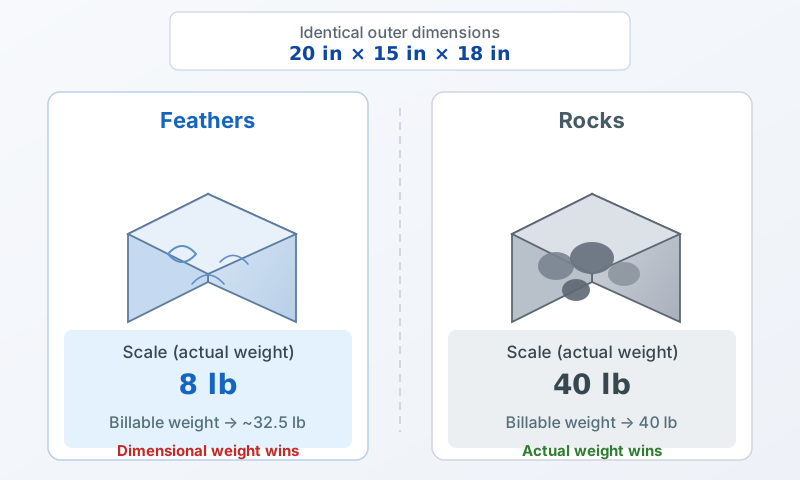
cubic inches = 20 × 15 × 18 = 5 400
cubic feet = 5 400 ÷ 1 728 ≈ 3.13 ft³
dimensional weight = 5 400 ÷ 166 ≈ 32.5 lb
- Feathers (8 lb actual): billable weight ≈ 32.5 lb (dimensional wins)
- Rocks (40 lb actual): billable weight = 40 lb (actual wins)
Same outer box; dimensional weight is the same. Only the scale reading changes which figure becomes billable.
Billable-weight calculator
Run your own numbers
Enter L × W × H, actual weight, and divisor to see billable weight.
When actual weight becomes billable weight
When the scale reading is higher than the size-based calculation—dense freight, heavy product in a compact carton, or freight that “weighs out” before it “cubes out.” The rock-filled carton in the visual below is this case.
When dimensional weight becomes billable weight
When the package is light relative to its outer size—feathers, foam, displays, soft goods in oversized boxes. The network prices the space, so dimensional weight becomes the billable figure. That is why light freight can still look expensive on the invoice.
Picture 2 cartons of the same outside size—both measure 20 inches long, 15 inches wide, and 18 inches tall.
One is full of rock samples; the other is full of feathers packed for retail. On a scale, the rocks might weigh 40 lb and the feathers only 8 lb. The carrier’s network cannot ignore how much room those boxes take. If pricing used scale weight alone, every shipper would send enormous boxes at minimum weight.
Dimensions usually matter as much as scale weight—and sometimes more.
Exceptions: minimums, rounding, and carrier rules
The greater-of rule is the backbone—not the whole tariff.
- Minimum billable weight — some services snap up to a floor even when both actual and DIM are low
- Rounding — at each dimension, after volume, after the divisor, or on billable weight; sequence matters
- Per-piece rating — multi-piece shipments may rate each outer separately
- Accessorials — oversize, additional handling, and similar fees can stack on top of billable weight
Know your carrier’s rounding rules for measurements, dimensional weight, and billable weight—and model them the way the tariff says.
I have seen shippers pay far more over a year because rounding in the carrier’s system did not match their spreadsheet assumptions. The interactive figure below shows how sensitive volume and dimensional weight are to where you round.
Measured each side (inches)
Default example (20.1 × 15.1 × 18.1 in, divisor 166)
| Rule | L × W × H (in) | Volume (in³) | Dim weight (lb) |
|---|---|---|---|
| Truncate down | 20 × 15 × 18 | 5,400 | ≈ 32.5 |
| Round each up | 21 × 16 × 19 | 6,384 | ≈ 38.5 |
Enable JavaScript for the interactive comparison.
Metric and LTL
Some tools quote in centimetres and kilograms. The logic is identical: volume in the carrier’s length unit, divide by a published factor, compare to scale mass. In less-than-truckload, you more often hear density and freight class than “dim divisor,” but the idea matches: light freight that cubes out still pays for space.
What to measure before you quote or book
- Outer points of the ready-to-ship package—not catalog SKU size
- Length, width, and height separately (not a remembered “standard box”)
- Fully packed weight on a calibrated scale
- The divisor that applies to your service and account
When comparing carriers, use the same measurements. A lower base rate with a harsher dimensional divisor is not automatically cheaper.
How to reduce billable weight
Often by shrinking the outer cube, cutting rated pieces, or changing mode or contract—when dimensional weight already beats actual weight.
Shrink the outer cube
When dimensional weight already beats actual weight, any reduction in ready-to-ship L × W × H (within the carrier’s measurement rules) cuts cubic inches and usually cuts billable weight.
- Right-size cartons and mailers. Match a small set of carton sizes and mailer formats to your SKU mix instead of one oversized default.
- Change void fill or inserts. Switch dunnage so the same SKU fits a shorter or smaller-footprint outer.
- Compress, nest, or ship flat. Vacuum or roll soft goods; knock down displays or kit furniture when the product allows.
- Tighten inner or retail packs. Keep channel-required sell cartons if you must, but minimize air between inner pack and the outer you tender.
- Packaging study. Pull dim-heavy invoice lines, trial a few new outers on a lane, then lock a simple matrix (order profile or SKU band → carton size). Pilot before you add many box SKUs. Full method: shipping packaging optimization and packaging study.
Fewer rated pieces (consolidation and overpack)
Tariffs usually rate each billable piece. Fewer outers can mean fewer dim-weight passes and fewer per-piece minimums—subject to weight, size, and sort limits.
- Combine order lines into one outbound carton when service rules allow.
- Master cartons instead of one outer per SKU on the line.
- Align “piece” in your WMS with how the carrier defines a piece for that service.
- Overpack multiple inners. One outer carton around several inner cartons: one outer L × W × H and fewer billable pieces than shipping each inner alone.
- Overpack—check the invoice stack. Per-piece fees may drop; the single outer can still trigger large package, oversize, overmax-style limits, or additional handling. One shock path and one claim; loose inners add damage risk. Size the outer to consolidated contents, not the largest stock carton.
Mode and contract (when the pack is already tight)
- Parcel vs LTL or pallet. Different networks use different rules; cube that hurts in parcel may rate differently on a pallet or in LTL.
- Service and product. Divisor, surcharges, and piece rules vary by service—compare programs with the same dimensions.
- Contract divisor. On some accounts the divisor is negotiable; it changes how cube maps to billable weight, not the carton itself.
What often moves the needle less
- Switching to lighter dunnage when outer dimensions stay the same. If dimensional weight already exceeds actual weight, shaving a few ounces of void fill does not change billable weight until you remove enough outer box to change L × W × H.
- Optimizing scale weight only. When dim drives the rate, the scale is not the constraint—cube is.
Tradeoffs you have to price explicitly
Keep in mind: smaller cube almost always trades against something else—damage rate, pack-station time, customer unboxing experience, return handling, or capital tied up in more box SKUs. Consolidation trades against speed-to-door and split-shipment flexibility. Mode changes trade against transit time and dock capability. The strongest programs I see treat packaging and routing as one decision: they model billable weight, accessorial risk, and damage cost together, not dimensional weight in isolation.
Practical takeaways
- Billable weight is what the rate uses—usually the greater of actual and dimensional weight
- Light, bulky freight often bills on dimensional weight; dense freight bills on the scale
- Measure the ready-to-ship outer; use the correct divisor; respect rounding and minimums
- Reduce billable weight by cutting cube and pieces—or by mode/contract—when DIM drives the rate
- Audit tender dimensions against the invoice before you close the period
Billable weight is not the only invoice mover: when dimensions or handling push a shipment into surcharge tiers, accessorial charges can stack on top.
Audit: warehouse dimensions and the invoice
- Warehouse aligned with carrier. Same outer points, same piece definition, same rounding sequence where you can.
- Second look at the invoice. Compare tender L × W × H and billable weight to the carrier’s lines. See how to audit freight accessorial charges.
For billable-weight rules inside a carrier agreement, see carrier contract rate analysis.
Dimensional weight shipping tips
- Measure the ready-to-ship outer—not the product alone—and use the same points the carrier will use.
- Know whether dimensional weight already beats actual weight before you spend effort on lighter void fill.
- Audit tender L × W × H against invoice billable weight every period; dim surprises are often measurement or rounding gaps.
If the scale says one thing and the invoice says another, start with dimensions. Billable weight is where actual weight and dimensional weight meet—and where the shipping charge is decided.
FAQ
What is billable weight?
The weight the carrier uses to rate the shipment—usually the greater of actual scale weight and dimensional weight. When the package is light but bulky, dimensional weight often becomes billable weight.
Why is 1,728 used in dimensional weight math?
There are 12 × 12 × 12 = 1,728 cubic inches in one cubic foot. Dividing L × W × H in inches by 1,728 converts volume to cubic feet for density and some tariff math. Parcel dimensional weight more often divides cubic inches by a published DIM divisor instead.
What is the difference between actual weight and dimensional weight?
Actual weight is what a calibrated scale reads. Dimensional weight converts outer L × W × H into a weight using the carrier’s DIM divisor. Billable weight is usually the greater of the two.
How can shippers reduce dimensional weight on invoices?
Cut ready-to-ship outer cube when dim already beats actual weight, consolidate pieces when it helps, consider mode changes when LTL prices cube differently, and negotiate DIM rules in the carrier contract when your history shows dim-driven spend.
What is the billable weight definition?
The weight the carrier uses to calculate the shipping charge—usually the greater of actual scale weight and dimensional weight, subject to minimums and rounding.
What is rated weight vs actual weight?
Rated weight is what enters the rate table (often identical to billable weight). Actual weight is the scale reading. When dimensional weight is higher, rated weight follows size.