
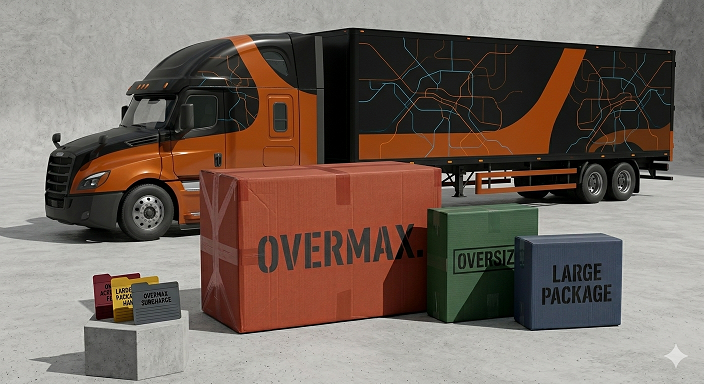
These labels are different rungs on the ladder of “this package is not a standard box,” but carriers do not use the words consistently. Generally: “large package” style fees kick in when dimensions cross intermediate thresholds; “oversize” often marks the next tier of length or combined length and girth; “overmax” (or similar) signals that the piece approaches or exceeds what the small-package network is meant to absorb routinely. Your tariff’s definitions—not the English dictionary—determine which label applies when.
What each concept is trying to capture
Dimensional weight and base rating already ask large light boxes to pay for cube. Size-tier accessorials stack when the piece still stresses equipment or flow even after billable weight is set. Think of three lenses:
- Intermediate large / bulky tiers: Early warnings that you have left the “everyday parcel” band—often tied to length or a combined measure.
- Oversize-style tiers: Higher stress on sort and linehaul—may combine length, girth, and weight checks.
- Maximum-envelope concepts (overmax-like): The shipment may require exception paths, may not be eligible for certain services, or may be priced as a different product altogether.
Carriers rename these tiers in marketing materials; your job is to map SKU-level dimensions to the tariff table row, not to the blog headline.
When each type of rule fires
Thresholds are granular: longest side alone, second-longest side, length plus girth, actual weight bands, and service-specific eligibility. A carton can trip a “large” tier without tripping “oversize,” or can jump straight to the highest tier if one dimension spikes. Remeasurement can shift which tier applies if your master data was wrong by an inch—carrier measurement protocols use longest protruding points.
A practical shipping example
A shipper moves automotive body panels in a thin but wide carton. Scale weight is moderate. Dimensional weight already sets billable weight high. The longest edge crosses the carrier’s first length threshold, which triggers a “large package” or equivalent surcharge. A different revision of the packaging adds two inches to the long edge only; now a second tier applies—sometimes labeled oversize—and the freight payment office assumes “we are being charged twice for the same thing.” In reality, billable weight and tiered surcharges answer different questions: how much cube competes with other freight, versus how awkward the piece is in machinery.
How they may appear on an invoice
Expect separate lines or bundled “adjusted charges” with codes. Large-package and oversize lines can appear on the same shipment if the tariff stacks tiers. If your analytics collapse all surcharges into “accessorial total,” you lose the ability to see whether the fix is packaging length versus girth versus a true overmax program.
What people confuse
Dimensional weight is not “the same as oversize.” Dim weight sets the weight column; oversize tiers add fees based on published limits. Additional handling can ride alongside size tiers when the shape is awkward. Disputes go sideways when teams argue about fairness without the tariff row in front of them.
How shippers can reduce or avoid stacking charges
- Model each SKU against the full tier ladder, not only dim weight.
- Test packaging reductions on the longest dimension first—often the cheapest lever to drop a tier.
- When you cannot shrink cube, compare parcel tiers to LTL with quoted accessorials; sometimes the mode switch removes ambiguity.
Final takeaway
Large, oversize, and overmax-style rules are separate dials in the tariff. Read them as additive constraints, pick the fix that moves the dial your data says is expensive, and keep dimensional and tier logic in separate columns in your freight reports.