

Picture 2 cartons of the same outside size—both measure 20 inches long, 15 inches wide, and 18 inches tall.
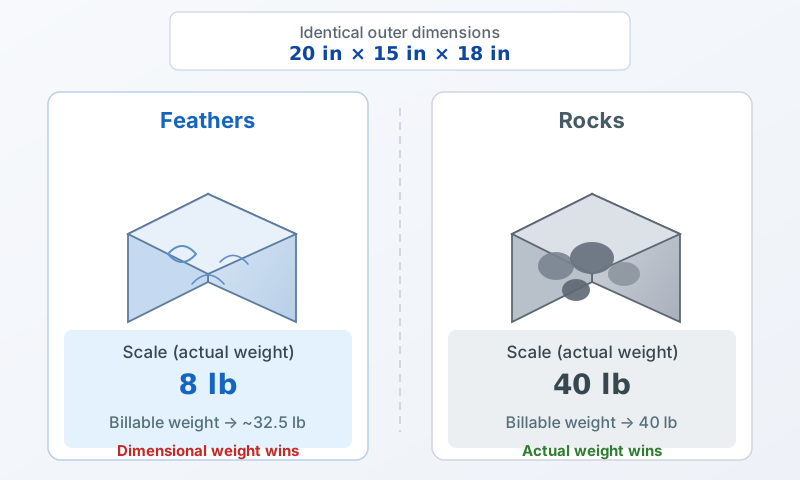
One is full of rock samples; the other is full of feathers packed for retail. On a scale, the rocks might weigh 40 lb and the feathers only 8 lb. The carrier’s network, though, cannot ignore how much room those boxes take on a belt or in a trailer. If pricing used scale weight alone, every shipper would send enormous boxes at minimum weight and the carrier would run out of cube long before it ran out of weight capacity.
That is the tension dimensional weight is meant to solve. The feather shipment is light, but it is still “heavy” in the sense that matters for the network: it occupies real volume that could have carried other freight. Carriers respond by converting that volume into a weight number—the dimensional weight—and comparing it to what the scale says. Whichever is higher becomes the billable weight for rating in most parcel tariffs.
I see the same pattern with shippers who move retail displays, sample kits, and foam-heavy products. The boxes are often under 15 kg on the scale, but tall and wide. Month after month the invoice looks high relative to weight because the billable weight is driven by dimensions, not by feathers-on-the-scale. Once the team started quoting with full length, width, and height—not just kilograms—the quotes lined up with reality.
This article explains what dimensional weight is, how North American parcel tariffs typically turn inches into cubic feet and then into pounds, why a divisor like 166 lines up with about 10 lb per cubic foot, and how that connects to the invoice you see as a shipper—whether you are moving rocks, feathers, or something in between.
What is dimensional weight?
Carriers move both weight and volume. A trailer or a courier container fills up when it hits a weight limit or when it runs out of space—whichever comes first. Dimensional weight is a pricing bridge: it turns the shipment’s outer size into a weight the tariff can use, so light-but-bulky freight pays something closer to the opportunity cost of the space it uses.
Dimensional weight—dim weight—is not a physical weight you can lift. It is a calculated weight from length, width, and height (usually the longest points of each side, including packaging), using rules the carrier publishes. In a typical parcel scenario, the carrier compares dim weight to actual scale weight and rates the shipment using the higher of the 2, subject to rounding and service rules. That is a common pattern, not a universal law: tariffs can also impose minimum billable weights, zone or piece rules, or other charges, so the invoice may reflect more than a simple max(dim, actual).
Actual weight versus billable weight
Actual weight is what a calibrated scale reads in pounds or kilograms for the shipment as tendered. Billable weight is the weight the carrier plugs into the rate after dimensional rules run. If dimensional weight exceeds actual weight, billable weight is usually the dimensional number. If the scale is heavier—as with the rock-filled carton—billable weight follows the scale.
2 shipments can read the same on a scale and still pay differently: different outer dimensions produce different dimensional weights. 2 cartons can have the same dimensions and pay differently if what is inside pushes actual weight above dim weight (rocks) or leaves actual weight below it (feathers). The invoice follows billable weight, not intuition.
How North American carriers turn dimensions into dimensional weight
In Canada and the United States, parcel tariffs are usually written in inches and pounds. The methodology you see on carrier sheets and in many transportation management systems follows the same backbone: measure the carton, compute volume in cubic inches, convert to cubic feet if you want a spatial intuition, then apply a published dimensional divisor to get dimensional weight in pounds.
From inches to cubic inches and cubic feet
Measure length, width, and height in inches—each at the longest point of the ready-to-ship package, per the carrier’s measurement rules. Multiply the 3 dimensions to get volume in cubic inches. There are 12 inches in a foot, so there are 12 × 12 × 12 = 1,728 cubic inches in 1 cubic foot. Cubic feet are therefore:
Volume
cubic inches = L × W × H (each side in inches)
cubic feet = cubic inches ÷ 1 728
The factor 1 728 is fixed: it is how many cubic inches fit in 1 cubic foot.
Dimensional divisor and pounds per cubic foot
Parcel carriers publish a dimensional divisor (sometimes called a dim factor in the sense of “divide by this number”). A common value in retail parcel programs is 166 for shipments measured in inches and rated in pounds. You may also see 139, 194, or other numbers depending on carrier, service, inbound versus outbound, or contract.
Dimensional weight in pounds is:
Dimensional weight (lb)
dimensional weight = cubic inches ÷ divisor
Example divisors you may see in North America: 139, 166, 194—always take the value from your carrier’s current tariff for your service.
Many people prefer to think in cubic feet. Because 1 728 ÷ 166 ≈ 10.4, a divisor of 166 implies about 10.4 pounds of dimensional weight for every cubic foot of volume. That is not a separate mystery constant—it is the same math rearranged:
Same result via cubic feet (divisor 166)
dimensional weight = cubic feet × (1 728 ÷ 166)
1 728 ÷ 166 ≈ 10.41 → often rounded in conversation to ~10.4 lb per ft³
If your divisor is 139 instead, 1 728 ÷ 139 ≈ 12.4 lb per ft³. The “pounds per cubic foot” shorthand always pairs with whichever divisor your tariff uses.
Billable weight for rating is then typically the greater of actual weight and dimensional weight, unless a minimum or a different rule applies for your service.
Worked example: same carton, feathers or rocks
cubic inches = 20 × 15 × 18 = 5 400
cubic feet = 5 400 ÷ 1 728 ≈ 3.13 ft³
Assume divisor 166:
dimensional weight = 5 400 ÷ 166 ≈ 32.5 lb
Check via cubic feet: 3.13 × 10.4 ≈ 32.5 lb
Same outer box; dimensional weight is the same for both. Only the scale reading changes whether you pay on dim (feathers) or on actual (rocks).
Metric and LTL
Some tools quote in centimetres and kilograms. The logic is identical: volume in the carrier’s length unit, divide by a published factor to get a dimensional mass, compare to scale mass. In less-than-truckload, you more often hear density (pounds per cubic foot or kilograms per cubic metre) and freight class than “dim divisor,” but the economic idea matches the feather-and-rock story: light freight that cubes out expensive still pays for the space it uses.
Why light freight can still be expensive
Space is the short answer. A large, light carton consumes shelf positions on a conveyor, floor positions on a trailer, and handling time relative to its scale weight. The carrier’s network is tuned so that bulky freight pays enough to cover that opportunity cost.
Operational reality is the longer answer. Oversize pieces may not run on standard automation, may require manual sort, and may trigger oversize or additional handling surcharges on top of dimensional billing. None of that contradicts dimensional weight; it stacks on top when the facts of the shipment cross thresholds in the tariff.
So “expensive” here does not mean the carrier is arbitrary. It means the shipment’s billable weight—driven by dimensions—is high relative to what a quick glance at the scale suggests.
Where the surprises come from
Surprises usually come from missing or rounded measurements, measuring the product but not the shipping carton, or using the wrong divisor for the service you booked. A few centimetres on one edge can move dimensional weight enough to cross a price break when volume is large.
Multi-piece shipments add another layer: carriers have rules for how dimensions combine or how each piece is rated. A consignment that looks like one “shipment” to you may still be several billable units under the tariff.
Audits after pickup are normal. If the carrier measures larger than what was quoted, billable weight moves, and the invoice follows the tariff. That is not unique to dimensional weight, but dimensional weight is where small input errors turn into large billable-weight gaps.
What to measure before you quote or book
Measure the outermost points of the ready-to-ship package, including padding and retail cartons—not the SKU size from a catalog. Use a consistent unit system that matches your carrier’s tool. Record length, width, and height separately; do not assume a “standard box” from memory.
Weigh the fully packed shipment on a calibrated scale. Then compute dimensional weight using the divisor that applies to your service and account, or let the carrier’s quoting tool do it if you feed accurate dimensions.
If you are comparing carriers, compare using the same measurements and the same assumptions about service level and surcharges. A lower base rate with a harsher dimensional divisor is not automatically cheaper.
Can you reduce dimensional impact?
Often, yes—by reducing air inside the carton, right-sizing packaging, or consolidating pieces so the outer cube shrinks without hurting protection. Packaging engineering and void fill choices are cost levers because they change the numerator in the dimensional formula.
Sometimes the right answer is not smaller packaging but a different mode or service that fits how the freight actually moves. The goal is not to “beat” dimensional weight—it is to align the shipment’s facts with the product you buy.
Practical takeaways
Dimensional weight exists so that light, bulky freight pays for the space and handling it uses. In typical parcel pricing, billable weight is based on the greater of actual scale weight and dimensional weight, subject to the carrier’s tariff—but that is not true in every case: minimum charges, contract terms, or other rules can change the outcome. That pattern is still why light freight can look expensive when the cube drives the rate. Your best defenses are accurate outer dimensions, the correct divisor for your service, and packaging that reflects how the carrier will measure the load—not how the product looks on its own.
If the scale says one thing and the invoice says another, start with dimensions. In parcel and in many LTL contexts, the story of the freight is written in length, width, and height as much as in kilograms—and the billable weight is where those stories meet.